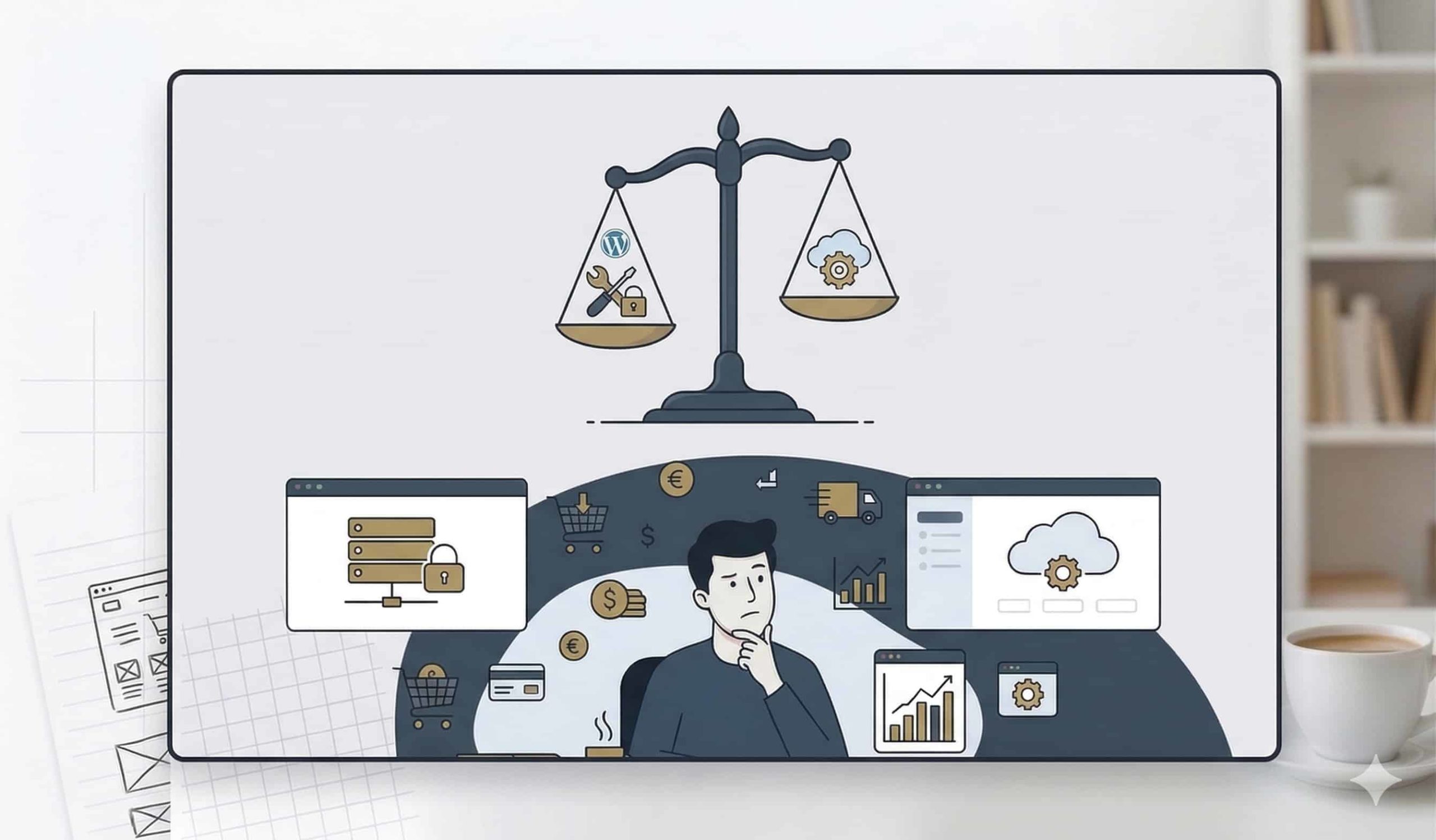
Here is a question we are asked in almost every initial business exchange about an e-commerce project: "What do you recommend — WooCommerce or Shopify?" And here's our honest answer: it depends. Not because we dodge, but because the real question is not what we think.
Studio Cassette is a WordPress agency. We build on WooCommerce, we know this ecosystem inside out, and we defend its benefits when they apply. But we are not here to sell you a solution that does not suit you. So in this article, we're going to do what few agencies do: give you a truly disinterested comparison — including when it concludes in favor of Shopify.
If you are comparing the two platforms, you are probably a few weeks away from an important decision. Take ten minutes to read the following. It could save you months of regret.
Two philosophies, not two identical tools
Before comparing features, you need to understand what these two solutions fundamentally represent — because the choice between WooCommerce and Shopify is first and foremost a philosophical choice.
WooCommerce is an e-commerce extension for WordPress. It's an open source software, free at its core, that you install on a hosting that you choose and that you master. You own your site, your data, your code. No one can decide one morning to change their pricing conditions and impact you overnight. In return, this freedom requires a minimum of technical commitment — or the use of specialists.
Shopify , it's the opposite in design. It's a SaaS (Software as a Service) solution: you pay a monthly subscription, and in exchange, everything is included — hosting, security, updates, support. You don't have to configure anything in depth. The quid pro quo? You do not own your technical environment. You are a tenant.
Neither of these approaches is superior in nature. They respond to different realities and projects. That's why any comparison that starts with "Shopify is better" or "WooCommerce is more powerful" without context is, at best, incomplete — at worst, biased.
What WooCommerce does really well
Let's first talk about the platform we work on on a daily basis — and fully assume what we think of its strengths.
Full ownership of your store
With WooCommerce, your store is yours. Your customer data, your catalog, your orders — it's all stored in a database that you control. You can migrate, duplicate, save, export without any restrictions. This is a huge advantage for businesses that think of their online presence as a long-term strategic asset.
Unlimited customization
Because it is built on WordPress — the world's most widely used CMS — WooCommerce benefits from a virtually limitless ecosystem of extensions and developers. Product feeds specific to your sector, complex pricing rules, tailor-made purchase funnels, integrations with your business tools: everything is technically feasible. Where Shopify can answer "this feature is not available in your plan", WooCommerce answers "anything is possible if you develop it".
SEO as a native competitive advantage
WordPress was designed from the outset with natural referencing in its DNA. URL management, internal linking, editorial content creation, integration with tools like Yoast SEO or Rank Math — all of this is natively more powerful and flexible than what Shopify offers. For an SME that wants to build its organic traffic over the long term, this is a structuring argument.
The economics of the project in the long term
This is a calculation that few people make at the time of choosing. WooCommerce requires a higher initial investment if you use an agency for development. But over three or five years, the absence of sales commissions, the control of hosting costs, and the scalability of the solution often make WooCommerce more economical than Shopify — especially for high-volume stores or those with complex needs.
This is what we are seeing in our e-commerce projects, especially in stores such as Prodiscol or Degriffmac : structures that needed flexibility, specific integrations, and real consistency between their brand identity and their purchasing experience. WooCommerce allowed us to build exactly what they needed — without compromise.
What Shopify does really well (and we assume it)
This is the part that many WordPress agencies carefully omit. Not us.
Simplicity of getting started
If you don't have any technical appetite, want to be up and running in a matter of days, and your priority is to sell — not run a site — Shopify is remarkably efficient. The admin interface is intuitive, the process of setting up a simple store is guided step-by-step, and you can add products, set up your shipping methods, and launch your first marketing campaign without ever opening a code file.
Effortless hosting and security
With Shopify, you never have to worry about server performance during a traffic spike, SSL certificates, or security updates. Everything is managed as part of the subscription. For an entrepreneur who wants to focus entirely on their business, this peace of mind has real value.
Permanent support available
Shopify has built-in customer support that can be accessed at any time. This is not a detail for a shop that sells at night or on weekends. With WooCommerce, your support depends on your web host and agency — which can be fine, or very insufficient, depending on the partners you've chosen.
Ideal for simple catalogs
If you have twenty or so references, no specific customization needs, and a direct sales logic, Shopify will give you 80% of the features you need effortlessly. It would be dishonest to deploy WooCommerce with all its complexity for a project whose needs Shopify would cover perfectly.
The real questions to ask yourself before choosing
Rather than giving you a universal answer that doesn't exist, here are the questions that, in our experience, really make the difference in this choice.
How complex is your catalog?
A catalog of a few dozen products with simple variations works great on Shopify. A catalog of several hundred SKUs with complex pricing rules, nested categories, and advanced filters will be best served by WooCommerce's flexibility.
Do you already have an existing WordPress site?
This is one of the most critical questions. If your current site is under WordPress — with its SEO, content, visual identity — adding WooCommerce is a natural extension. Migrating to Shopify would mean starting from a blank page on another system, with all that that entails in terms of SEO costs and risks.
What is your appetite for the technical side?
Let's face it: WooCommerce requires either in-house technical competence or a trusted partner for updates, security, and upgrades. If you never want to hear about the technical part and manage everything solo, Shopify will reduce your mental load significantly.
How do you envision your SEO growth?
If your acquisition strategy relies heavily on SEO — editorial content, technical optimization, internal linking — WooCommerce will give you levers that Shopify can't fully match. If your growth is mainly through paid advertising and social networks, this advantage is less decisive.
What is your initial budget to recurring cost ratio?
Shopify has little upfront cost but an ongoing monthly subscription, plus potential commissions depending on your plan. WooCommerce is usually a higher development investment initially, but structurally lower recurring costs — especially as your store grows.
Two hypothetical situations to clarify the choice
To make this comparison concrete, here are two general — clearly hypothetical — cases that illustrate how this choice is made in practice.
Imagine an independent craftsman or creator which is launching its first store with about twenty references, without internal technical resources and with a tight budget. His priority is to be online quickly, to sell, and not to spend his evenings managing a server. In this case, Shopify is probably the best gateway to e-commerce. That's honest advice — even if it doesn't generate a development mission for us.
Now imagine an SME which already has a well-referenced WordPress site, with a catalog of several hundred products, integration needs with its ERP, a real content strategy and the ambition not to depend on a third-party platform. For this profile, WooCommerce is not only more suitable: it is probably more economical over five years, more powerful in SEO, and more consistent with the entire digital ecosystem already in place.
Why Studio Cassette chose WooCommerce — and why it's not neutral
We have made a deliberate choice of specialization: WordPress and WooCommerce. This is not by chance, and we will explain why — without claiming that it is the universal truth.
We believe deeply in customer freedom. Every site we deliver is entirely owned by its owner. No dependency on a platform, no subscription that conditions access to your own store. If tomorrow you want to change agencies, migrate your hosting or develop your site with another team, you can do so without any constraints. This is the nature of open source, and it's a value we share with our customers.
We also believe that SEO is one of the most sustainable assets a business can build online. And in this field, WordPress and WooCommerce remain, in our experience, the most efficient and flexible combination on the market.
Finally, we love custom projects. Stores that truly reflect the brand that carries them, that meet specific needs rather than a list of generic features. WooCommerce allows us to build that — and that's what gives meaning to our work.
But all this does not mean that WooCommerce is the right answer for you. That's why we always prefer to start by understanding your project before guiding you towards a solution.
So, WooCommerce or Shopify? The real answer.
The real answer is: neither one nor the other by default. The right e-commerce platform is the one that fits your project, your resources, your strategy, and your way of working. Everything else is commercial noise.
What we hope to have brought you in this article is not a conviction — it is a method. The questions to be asked, the trade-offs to be considered, the difference in philosophy between the two approaches. With these benchmarks, you're now better equipped to make an informed decision — whether you choose to work with us or not.
If your project points you towards WooCommerce, if you have an existing WordPress site to evolve, or if you simply want an outside perspective on your situation before making a decision, we are here for that.
Let's talk about your e-commerce project — without obligation
Studio Cassette offers a free and personalized initial exchange around your needs. No sales pitches, no response templates: a real conversation with people who know their stuff and who will tell you what they think, even if it doesn't coincide with their immediate interests.
That's the spirit of a human-sized agency.